
Gateway Fact Check
In today’s fast-moving digital environment, information can spread quickly… and not always accurately.
GSCDD created this page to clarify common questions, address rumors, and provide context on issues circulating in our community. Here, you’ll find reliable, up-to-date information directly from GSCDD. Our goal is to provide transparency, build trust, and ensure residents have access to clear and factual information about their community.
Thank you for staying engaged with what’s happening in Gateway. If you have questions or concerns, please reach out to us directly.
Fact Check
How are decisions made in the District, and who is in charge?
Short Answer:
The District is governed by a Board of Supervisors who make decisions in public meetings.
The Facts:
All major decisions, including budgets, rates, and capital projects, are discussed and approved during publicly noticed meetings. Residents have the opportunity to attend, provide input, and stay informed.
District staff and consultants provide recommendations, but final decisions are made by the Board in accordance with Florida law.
Why is the District going to start charging for parking at parks now?
Short Answer:
To help offset costs while ensuring residents are not solely responsible for funding facility use by non-residents. The rollout of parking fees will occur in the new fiscal year starting Sept. 1, 2026
The Facts:
The Board has implemented a parking system where:
–Non-residents: $2/hour parking fee
–Residents: Free permit tied to license plate registration
The District has approved a contract with Premier Parking (same system used by Lee County).
This system is designed to:
-Generate revenue from non-resident users
-Reduce reliance on resident assessments
-Support ongoing maintenance of parks and facilities
What role does the District play in the development of Gateway?
Short Answer:
Development is approved by local governments, while the District provides and maintains infrastructure and ensures these developments meet requirements per the GSCDD’s Permit Criteria Manual for utilities (irrigation, potable & wastewater) and stormwater management.
The Facts:
Land use and zoning decisions are handled by the county or city, not the District.
GSCDD’s role is to plan, construct, operate, and maintain infrastructure such as water systems, roadways, stormwater systems, and recreational amenities that support the community.
As growth occurs, infrastructure must expand to meet demand, which is one reason long-term planning and investment are essential.
What development is happening within the District and surrounding area?
Short Answer:
Development is ongoing both within the District and in the surrounding areas of Fort Myers and unincorporated Lee County, with projects in various stages of planning, approval, and construction.
Residents can view active and proposed development through Lee County’s interactive dashboard:
https://edo-leegis.hub.arcgis.com/pages/developmentactivity
Orange River-Puma T36419 Transmission Line Project: Info
Answer:
Yes, FPL does not own the land, but it has the legal right to install and construct FPL facilities, including electric transmission and distribution lines, within District-owned areas where it is the owner and holder of utility easements. In the case of the Linear Park, that legal right exists by virtue of longstanding, existing transmission and distribution line easements.
The Facts:
FPL will be building a second transmission line within existing FPL easements in Gateway, alongside the existing line. FPL has engaged surveyors to delineate/verify the extent of its easements within the Linear Park to ensure work related to the Orange River-Puma T36419 Transmission Line Project remains within the FPL easements.
This is not a District project. However, residents have raised concerns regarding the upcoming FPL project, and GSCDD has taken the following actions in response:
-Requested a community town hall meeting with FPL to explain project scope, impacts, and expectations.
-Requested a dedicated project webpage to provide updates, project details, and a centralized source of information for residents.
-Initially received resident concerns and forwarded them directly to FPL; as a result of GSCDD’s request, FPL has now established a dedicated project email inbox so residents may submit inquiries directly.
–Met directly with FPL representatives to communicate resident concerns and obtain project information.
-Shared project updates with community associations as information is received from FPL.
Residents may submit questions or concerns directly to FPL at: OrangeRiverPumaProject.SharedMailbox@fpl.com
-FPL will be clear-cutting the easement for the project/construction activities.
–Safety, reliability, and construction requirements are deciding factors in this decision.
–Tree impacts will be minimized where feasible, however it is likely FPL’s entire easement will need to be cleared.
-Project anticipated to start towards the end of this calendar year/early next year.
–As this project is still in the design stage, timeframes are approximate and subject to change. Once plans have been finalized and this project is ready for construction, more concrete timeframes can be provided. Construction will occur in the phases listed below. Each timeframe is an estimate specific to the Gateway community area. Phases may not occur consecutively, and advance notice will be provided prior to the start of each phase:
–Civil work, including vegetation clearing: 2 months
–Concrete foundation installation: 1 month
–Structure and wire installation: 1 month
-Project in design. Working through design/permitting.
-Structures and lines to remain within the easement in its entirety. No portions of the facilities will overhang properties outside of the FPL easements.
-Access to the easement will be through the existing easements adjacent and/or public roadways.
Is the District Planning to do anything with the Dog Park?
Answer:
At this time, the Dog Park remains open and operational.
On May 7, 2026, the Board of Supervisors directed staff to evaluate long-term planning scenarios for parks and recreation amenities. This includes reviewing potential options for the Dog Park, such as relocation or operational adjustments. At this time, no final action has been taken.
On June 2, 2026, the Parks and Recreation Advisory Committee (PRAC) evaluated the options below and provided a recommendation to the Board of Supervisors. The options under consideration included:
-Option 1: Approve a relocation concept to Fun Park location utilizing combination-lock access
-Option 2: Approve a relocation concept Fun Park location utilizing fob-access/security controls
-Option 3: Temporarily close the Dog Park until it can be relocated to Commons Park
-Option 4: Sunset (discontinue) the Dog Park entirely
-Alternative Direction: Provide staff with additional direction regarding project layout, amenities, or operational features
The third option was recommended by the PRAC for the Board of Supervisors’ consideration. Any future action regarding the Dog Park would require Board of Supervisors review and approval at a public meeting.
Sherman Soccer Complex rates
The Facts:
The Gateway Services Community Development District (GSCDD) sets facility-related fees only, such as:
-Field rental rates
-Light usage fees
-Parking rates (where applicable)
-Facility usage policies and scheduling rules
However, independent leagues and user groups:
-Set their own registration fees
-Determine their own program pricing
-Decide how costs are passed on to participants
These organizations operate separately from the District, even though they use District-owned facilities.
Short Answer:
Rates remained flat for many years and only began increasing in recent years to address long-standing cost pressures.
The Facts:
The most significant rate increases began in 2023 after a prolonged period of flat pricing. During that same time, leagues continued to increase participant registration fees to offset their own rising operating costs, while the District relied more heavily on taxpayer support to keep field rental rates artificially low.
As a result, residents effectively subsidized a growing portion of facility operations through the District’s broader budget. Even with the proposed 2026 rates, Field Rental at $134/hour and Light Rental at $35/hour, the District still projects that rentals would cover only about 50% of total operating and capital-related costs.
Moving forward, the District’s approach is focused on shifting more of the financial responsibility to facility renters, reducing the burden on residents while maintaining sustainable access and long-term facility quality.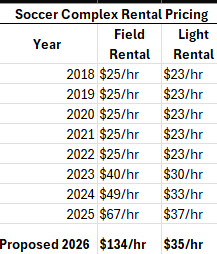
Answer:
The District is experiencing rising operational and maintenance costs associated with increased usage, aging infrastructure, and ongoing upkeep requirements of the facility.
To ensure long-term sustainability and continued service to the community, the District has identified several planned improvements, including:
-Parking lot expansion to improve capacity and circulation
-A sidewalk along the Gateway Boulevard frontage to enhance pedestrian safety and connectivity
-Sod replacement in heavily used athletic areas
-Irrigation system upgrades to improve efficiency and reduce water costs
-Upgraded field lighting to improve safety and extend usable hours
These improvements are part of a long-term effort to maintain facility quality, improve safety, and manage rising operational demands.
Short Answer:
These changes are part of the District’s annual budget process, which evaluates costs, revenues, and infrastructure needs for the upcoming year.
The Facts:
Each year, the Board of Supervisors reviews:
-Actual expenses from prior years
-Projected operating costs for the next fiscal year
-Long-term capital needs (facilities, lighting, fields, parking)
-Revenue sources such as taxes, rentals, and user fees
This ensures the District can maintain services and plan responsibly for infrastructure needs.
For example, the Sherman Soccer Complex alone is now projected to require approximately $3 million in capital improvements over the coming planning cycle (lighting, parking expansion, and field renovations).
Because these costs are known in advance of the fiscal year, rate adjustments are discussed before the budget is finalized, not after.
Short Answer:
Because the District only has about 10,000 households funding these facilities, and costs continue to rise.
The Facts:
Only properties inside District boundaries contribute through assessments. Properties outside the District:
-Do not pay for field maintenance
-Do not contribute to capital improvements
-Still use the facilities
To reduce burden on residents, the District is intentionally shifting toward diversified revenue sources, including:
-Parking revenue (excludes residents)
-Concessions
-Sponsorships and naming rights
-Adjusted rental rates
-In-house operations to reduce contractor costs
Answer: Yes. The District has initiated external discussions and evaluated multiple alternatives for the management of the Sherman Soccer Complex. These options have included bidding the facility out to a professional management company, exploring a cost-share or split-management model, and considering internal league management structures, among other approaches. The sale or transfer of the facility has also been explored.
The Facts:
The Board formally reached out to the Lee County Board of County Commissioners to determine whether there was any interest in acquiring or purchasing the Sherman Soccer Complex.
At this time:
-No response has been received from Lee County.
-The District continues to operate and maintain the facility.
Answer:
Yes. While some fees are increasing, the overall structure is designed to limit tax increases for residents, shift costs toward facility users and non-residents, and fund long-term improvements without overburdening taxpayers. The goal is not simply to raise fees it is to prevent a long-term decline in facilities that could ultimately cost residents more.
Did the District replace my water meter twice?
Not likely. All GSCDD customer meters are scheduled to be replaced only once as part of the District’s Advanced Metering Infrastructure Replacement Project. However, if your home was selected to participate in the pilot program, your meter may have been replaced a second time as part of testing and evaluation before the final contractor was selected. Participating residences were notified in advance.
As part of the pilot program, some properties received meters from manufacturers that were not ultimately selected by the District. These meters will be replaced with the District’s final selected meter and communication endpoint as installation progresses.
Some customers may incorrectly believe their meter was replaced twice because the District completed preliminary meter box replacement/relocation work at all properties before the meter replacement project began. Meter box relocation and meter replacement are two separate activities.
GSCDD began the first phase of installations on June 1, 2026. Water usage monitoring will become available once your property has received a new smart meter and your community’s installation phase has been completed. Notification emails with instructions for accessing water usage data will be sent to customers upon completion of installations within their community.
The project is being implemented community by community and is expected to be completed by October 2026.
More information: www.gatewaydistrict.org/smart
Have a question or heard a rumor about GSCDD services, programs, or decisions? Email us: customercare@gatewaydistrict.org
For information about ongoing District projects, visit gatewaydistrict.org/districtprojects